The Effects of Method of Information Delivery on Working Memory
Project Context
This academic research project was conducted as part of PSYC 217 at UBC’s Department of Psychology. As students curious about how people best retain information, my team and I investigated how the method of information delivery (reading versus listening) affects immediate comprehension and working memory. We designed an experimental study comparing comprehension performance between participants who read a fictional passage and those who listened to the same passage spoken by an artificial voice.
My Role & Responsibilities
Being a small group and study, I contributed to all stages of the project including experimental design, recruitment and coordination of participants, administering the study, and data collection. I also assisted in analyzing behavioral results and synthesizing findings for our final report.
Research Methods
We ran a between subjects experiment where participants (N=20) were randomly assigned to one of two groups: a reading group and a listening group. Each participant engaged with the same fictional passage, either by reading it or listening to an artificial voice narration. Afterward, participants completed a 14-question multiple-choice comprehension survey designed to assess immediate understanding and retention of the material.
Outcome
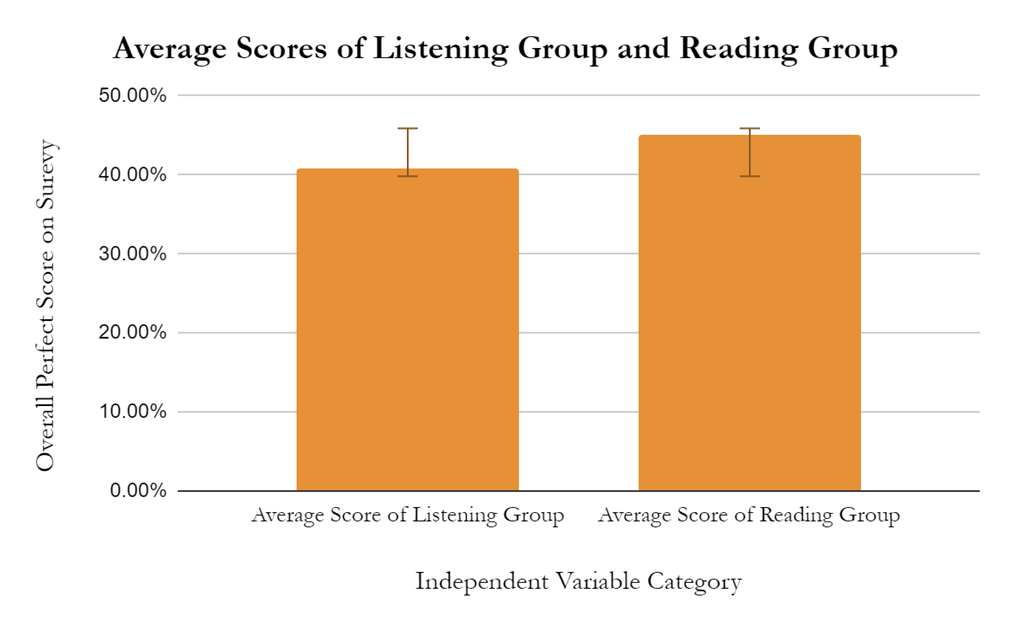
The reading group outperformed the listening group on the comprehension survey, supporting our hypothesis and aligning with prior literature on attention and modality-based learning.
Fig. 1: Results of listening vs reading groups
Reflection
This project strengthened my skills in designing controlled experiments, conducting behavioral data analysis, and working with human participants in general while also deepening my understanding of cognitive processes related to learning and memory.
** Updates in progress, more on this case study coming soon!